
Discover Mateo’s artistic journey and the story behind his painted rugs, where portraiture, ornament, and cultural memory merge to reveal the intimate landscapes beneath the surface.
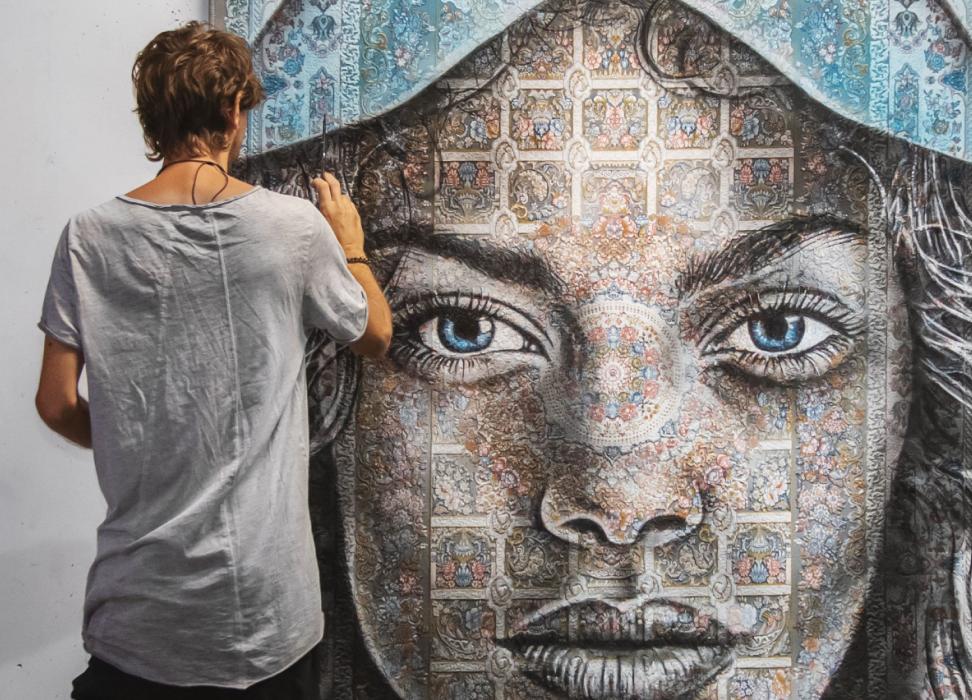
Mateo: Revealing the Inner Garden
Updated: June 03 2026
Explore Mateo’s artistic journey, where contemporary portraiture, antique textiles, and ancestral ornament come together to uncover the intimate landscapes that exist beneath the surface.
In the work of Mateo, a portrait is never simply placed upon a surface. It emerges from within it.
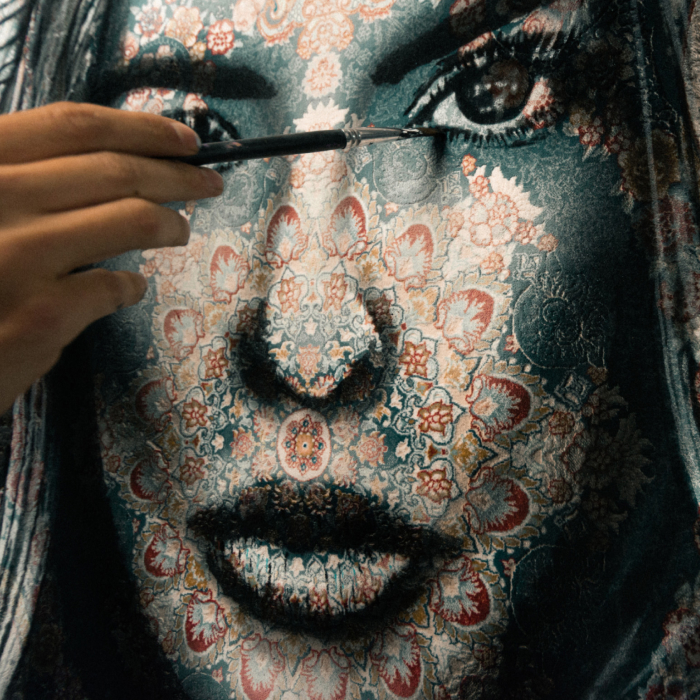
Working with antique rugs, the French-born, Montreal-based artist reveals faces through the intricate patterns of the textile, allowing ornament, memory, and identity to become inseparable. The rug is not merely a canvas. Its existing structure becomes an emotional map, carrying traces of culture, craftsmanship, and collective history.
At the heart of Mateo’s practice lies the idea of the “inner garden”: a symbolic space beneath the visible surface, where the human form and ornamental pattern merge. Shaped by years of academic study, international travel, traditional craftsmanship, and mural practice, his work exists between raw expression and refined precision.
In this conversation with EDEN, Mateo reflects on the experiences that shaped his visual language, the meditative discipline behind his process, and the quiet sense of presence he hopes each work brings into a collector’s home.
Origins
EDEN: Where does your story as an artist begin?
Mateo: I have been drawing and painting for as long as I can remember.
I studied fine arts for six years and completed a master’s degree, building a foundation in art history, aesthetics, and philosophy. I then spent years traveling, immersing myself in different cultures and traditions of craftsmanship.
After that, I painted in the streets for over a decade, developing my visual language through mural practice. The rug series emerged from this entire journey and continues to evolve today.
EDEN: Was there a moment when you knew art would be central to your life?
Mateo: It became clear over time that everything I was drawn to—travel, culture, and human presence—naturally converged into art.
There was, however, a decisive shift during an isolated silent retreat on Isla del Sol in Peru. In that stillness, it became clear that I would dedicate my life entirely to this path.
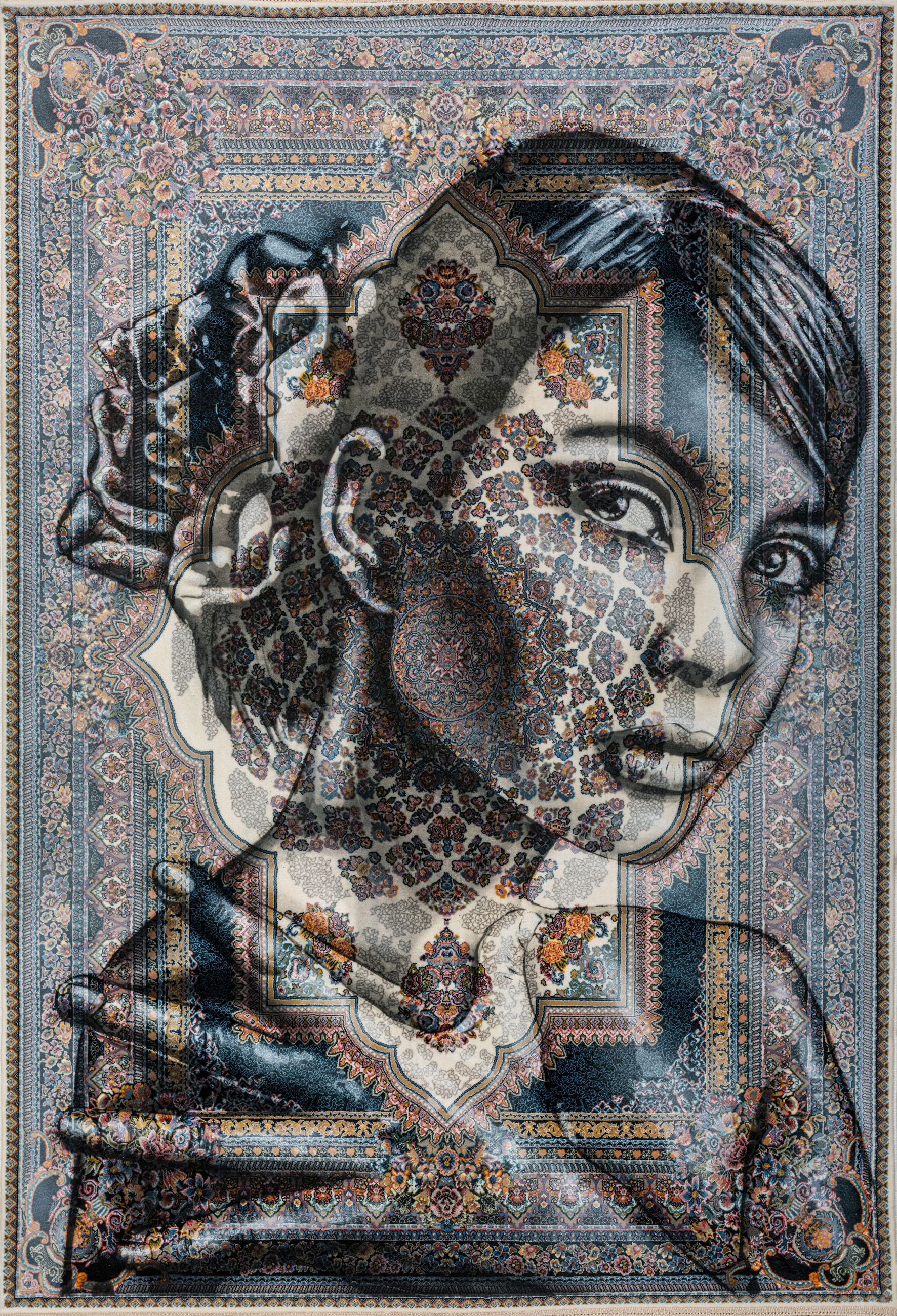
Mateo, Muta, Spray Paint on Persian Carpet
Language & Identity
EDEN: What themes or ideas do you return to most often?
Mateo: I constantly return to the idea of the “inner garden,” a space that exists beneath the surface of the body.
My work explores identity through cultural memory, ornament, and symbolism. The patterns I use are not decorative; they act as emotional cartographies.
Travel is also essential to my process. I am continually discovering cultures, symbols, and traditions of craftsmanship, and translating them into a contemporary visual language.
Process & Discipline
EDEN: How do you know when a work is finished?
Mateo: A piece is finished when there is no longer any separation between the portrait and the structure beneath it. When the face no longer feels painted on the surface, but revealed from within it.
EDEN: How do you approach moments of doubt or creative block?
Mateo: I do not resist them. Doubt is part of the process. It usually means that something has not yet been resolved.
I work extensively on preliminary drawings, and I only begin painting when the composition feels completely clear. Once I start working on the rug, there is no room for mistakes. The surface cannot be erased.
Emotion & Meaning
EDEN: What do you hope someone feels when living with your work?
Mateo: A sense of presence. A serene, almost intimate atmosphere. Something grounding, like a quiet form of home.
Ideally, the work becomes a mirror, reflecting the inner landscape of the person living with it.
EDEN: Is there a work that feels especially personal to you?
Mateo: The first portrait I painted on a rug was a turning point.
It was the moment when everything aligned: my background in street art, my attraction to ornament, and a deeper conceptual direction. It did not feel like an experiment. It felt like a discovery.
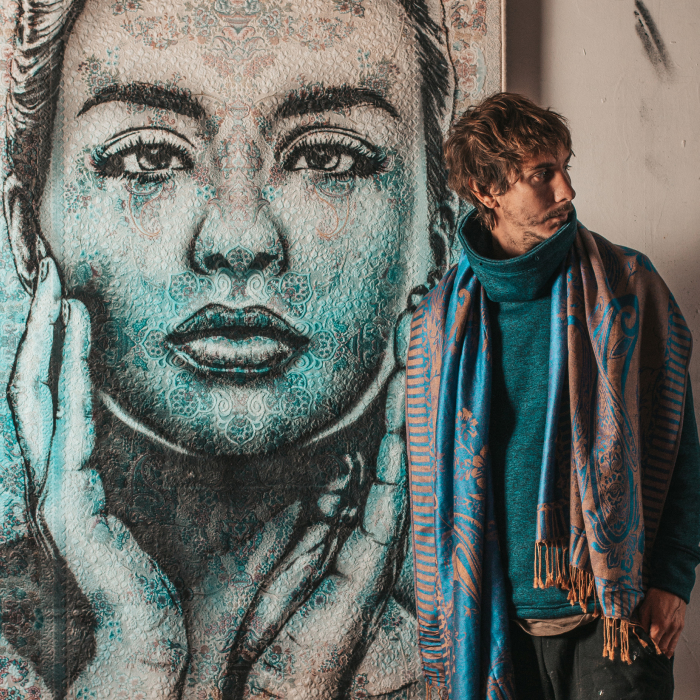
Dialogue with the World
EDEN: Which artists have influenced your thinking the most?
Mateo: Banksy and C215 influenced my understanding of stencil and layered meaning. Vhils shaped the way I think about revealing what lies beneath the surface.
I am equally influenced by traditional craftsmanship, especially textile, architecture, and ornamental traditions. More than specific names, it is the dialogue between contemporary expression and ancestral knowledge that defines my practice.
EDEN: Do you see your work as part of a particular movement or culture?
Mateo: I see my work as a bridge. It connects street culture with traditional craftsmanship, and contemporary portraiture with historical ornament.
It exists between territories rather than within a single movement.
EDEN: What role does the artist have today?
Mateo: To create meaning in a fragmented world.
We are constantly exposed to images, but very few create depth. The role of the artist is to slow that down and create spaces where people can reconnect with something essential.
The Collector’s Perspective
EDEN: Who do you imagine living with your work?
Mateo: Someone who values depth over immediacy.
Not simply someone who wants to own an image, but someone who wants to live with a presence—something that inspires them and evolves with them over time.
EDEN: How do you see the relationship between artist and collector?
Mateo: It is a relationship based on trust.
The collector becomes the guardian of the work, and the work continues its life through them. For me, it is not a transaction. It is a transmission.
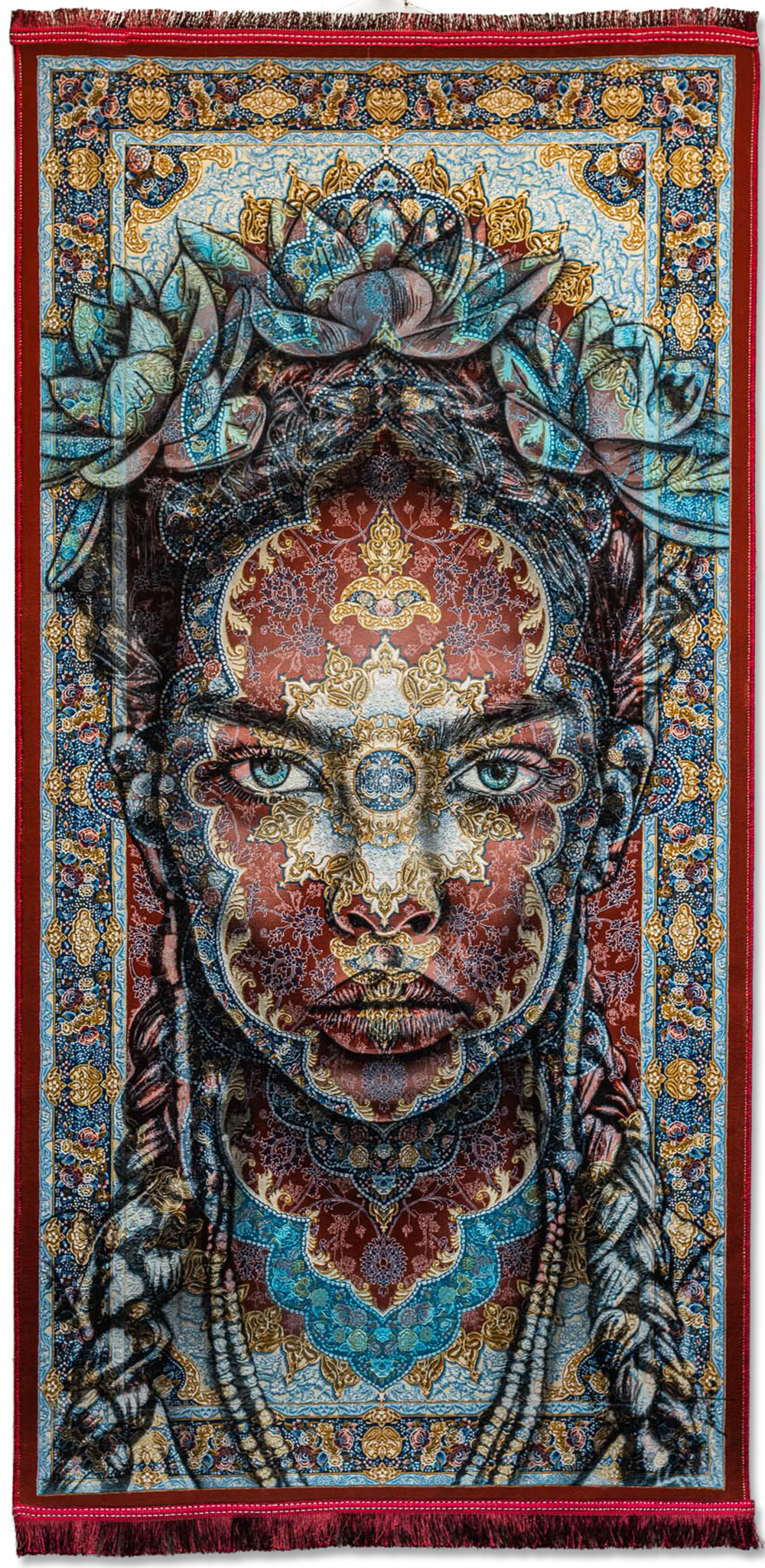
Mateo, Ruby Royal, Spray Paint on Persian Carpet
Signature
EDEN: What is something people would be surprised to know about you?
Mateo: That my path has never been linear.
I have moved through different worlds, from underground music scenes to graffiti culture, from solitary travel to exhibiting in international institutions.
At the same time, I have developed a more introspective discipline, learning to step back, to observe, and to question perception beyond habitual ways of seeing. These experiences shaped the way I see.
Today, that same tension remains in my work: between raw expression and refined structure, between intuition and precision.
I do not construct images.
I uncover them.