
In the first edition of the EDEN Expert Series, interior designer Charrisse Johnston explores how meaningful art can transform a beautifully styled interior into a space that feels deeply personal. Drawing on her expertise in design, behavioral biology, and neuroaesthetics, she reflects on the power of art to evoke memories, inspire joy, and create a true sense of home.

The Art of Feeling at Home
Updated: June 16 2026
How meaningful art can transform an interior into a space of comfort, connection, and human delight
Introducing the EDEN Expert Series
Art does not exist in isolation. It enters our homes, shapes our environments, enriches our experiences, and becomes part of the way we live.
The EDEN Expert Series is a recurring editorial feature bringing together leading voices from the worlds that intersect with art and collecting, from architecture, design, and hospitality to wellness, yachting, and luxury lifestyle.
Through thoughtful conversations, interviews, and personal perspectives, each edition invites an expert to share insights from their field and explore the ideas shaping contemporary living. Created to inform, inspire, and spark meaningful dialogue, the series offers a fresh perspective on the many ways art connects with the spaces we inhabit, the experiences we seek, and the objects we choose to surround ourselves with.
For the first edition of the series, we invited Charrisse Johnston, Principal and founder of StudioSALT, to reflect on the role of art within the home. Drawing on her experience in interior design, behavioral biology, and the neuroscience of built environments, she considers what transforms a beautifully styled interior into a space that genuinely resonates with the people who inhabit it.
The Art of Feeling at Home
By Charrisse Johnston
When people learn that I am an interior designer, they often ask me about the latest trends. They are usually surprised, and occasionally even perturbed, when I tell them that I am not particularly interested in what is “in” or “out.”
“Why not?” they ask. “Isn’t it your job to make spaces look beautiful?”
That question brings us to the heart of the distinction between interior decoration and interior design. Both are important, respected, and worthy pursuits, but they do not always serve the same purpose.
Interior decoration is often focused on visual impact: what photographs beautifully, what feels current, and what captures attention. Interior design, by contrast, is concerned with how a space makes its inhabitants feel. It takes into account all five senses, as well as the activities, emotions, and everyday rituals that unfold within a room.
A carefully decorated space may earn a million likes on Instagram while still feeling uncomfortable, confusing, or impractical to inhabit. Conversely, an impeccably designed room with excellent acoustics, ergonomic furniture, thoughtful lighting, and intuitive movement can still feel uninspiring or generic.
A truly exceptional space requires both. It should function beautifully, but it should also invite its inhabitants to thrive.
Beyond Decoration
The idea of beauty is deeply personal, yet our responses to it are also connected to the way our minds and bodies experience the world.
The emerging field of neuroaesthetics explores the relationship between aesthetic experiences and the brain. It considers how art, architecture, music, and design can influence our emotions, memories, perceptions, and sense of well-being.
Susan Magsamen and Ivy Ross explore these ideas in their book Your Brain on Art: How the Arts Transform Us, examining how creative and aesthetic experiences can contribute to our physical and mental health, encourage learning, and strengthen our connection to the world around us.
The relationship between beauty and well-being is also reflected in the WELL Building Standard, a framework designed to support human health through the built environment. Its principles recognize the value of comfort, culture, meaningful public art, and something wonderfully difficult to quantify: human delight.
This idea feels especially significant when we consider the role of art within the home.
Art should not be treated as an afterthought, selected simply because its colors coordinate with the furniture or because it suits a passing aesthetic trend. A meaningful artwork is the antithesis of fashion. It is enduring. It reflects something personal about its owner: a memory, an instinct, a fascination, or a feeling that cannot always be explained.
The most powerful pieces do not need to appeal to everyone. They are not chosen to impress every visitor. Their purpose is to resonate with the person who lives with them.
The Artworks That Stay With Us
With that in mind, I explored EDEN’s extensive collection and found myself drawn into a world of color, texture, emotion, and memory.
Even while scrolling through the artworks online, I noticed how quickly certain images evoked a response. Some inspired curiosity. Others prompted reflection. A few made me smile immediately.
Two pieces captivated me for very different reasons.
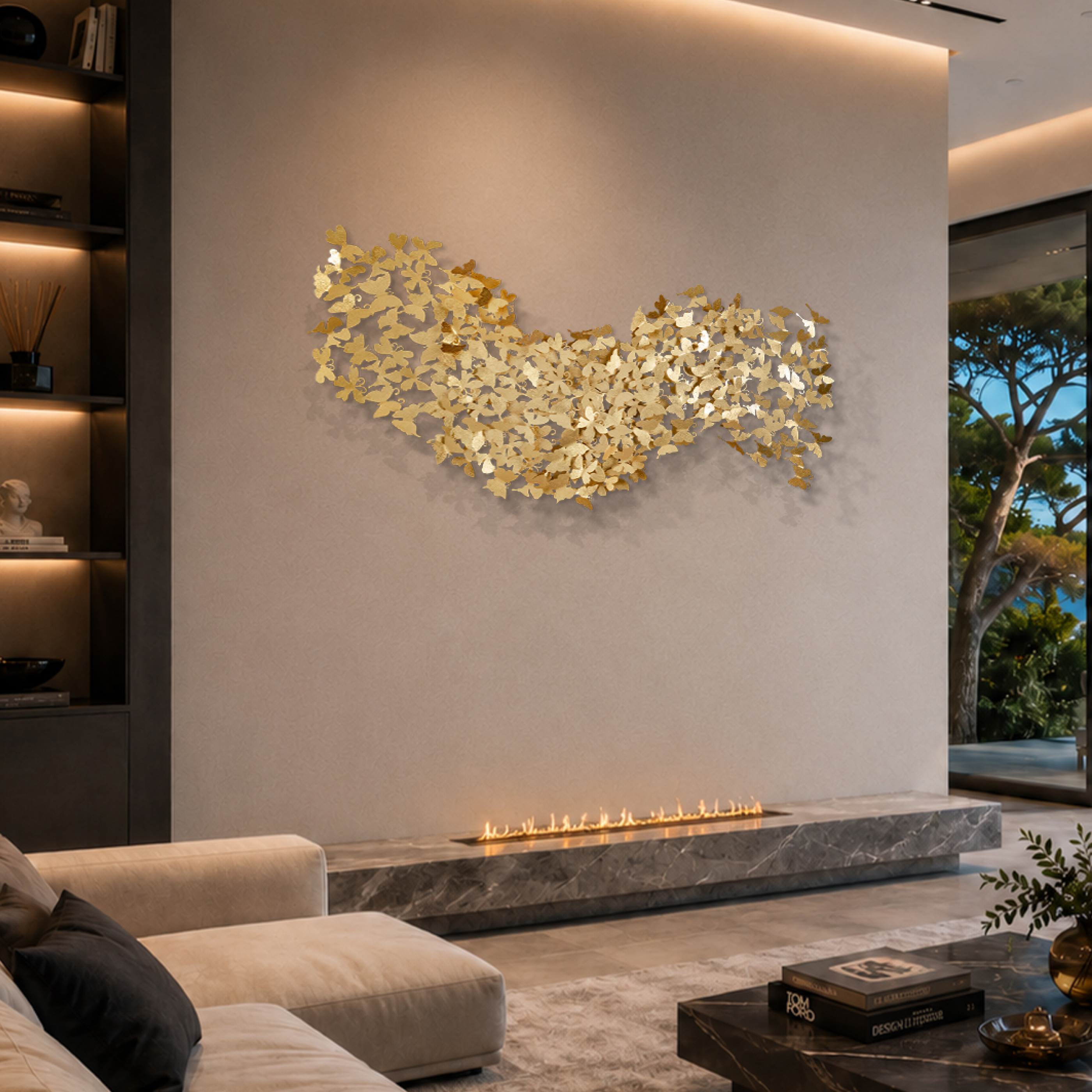
The first was Dark Side of the Moon IX by Daniel Gastaud.
At first glance, the artwork appeared to be a mysterious yet relatively straightforward close-up of the moon. Its deep shades of gray and black seemed to reveal new nuances the longer I looked. The repeated patterns of the craters, both large and small, felt simultaneously familiar and mesmerizing.
Then I read that the piece was created using photography and feathers.
Feathers?
That unexpected detail completely changed my perception of the artwork. I wanted to see it in person, to step closer, and to understand where the feathers had been applied and how they shaped the surface of the piece. It became not only an image of the moon, but also an invitation to explore texture, material, and illusion.
The second artwork stopped me in my tracks for an entirely different reason.

Daniel Gastaud, Dark Side of the Moon IX, Original Feather Composition
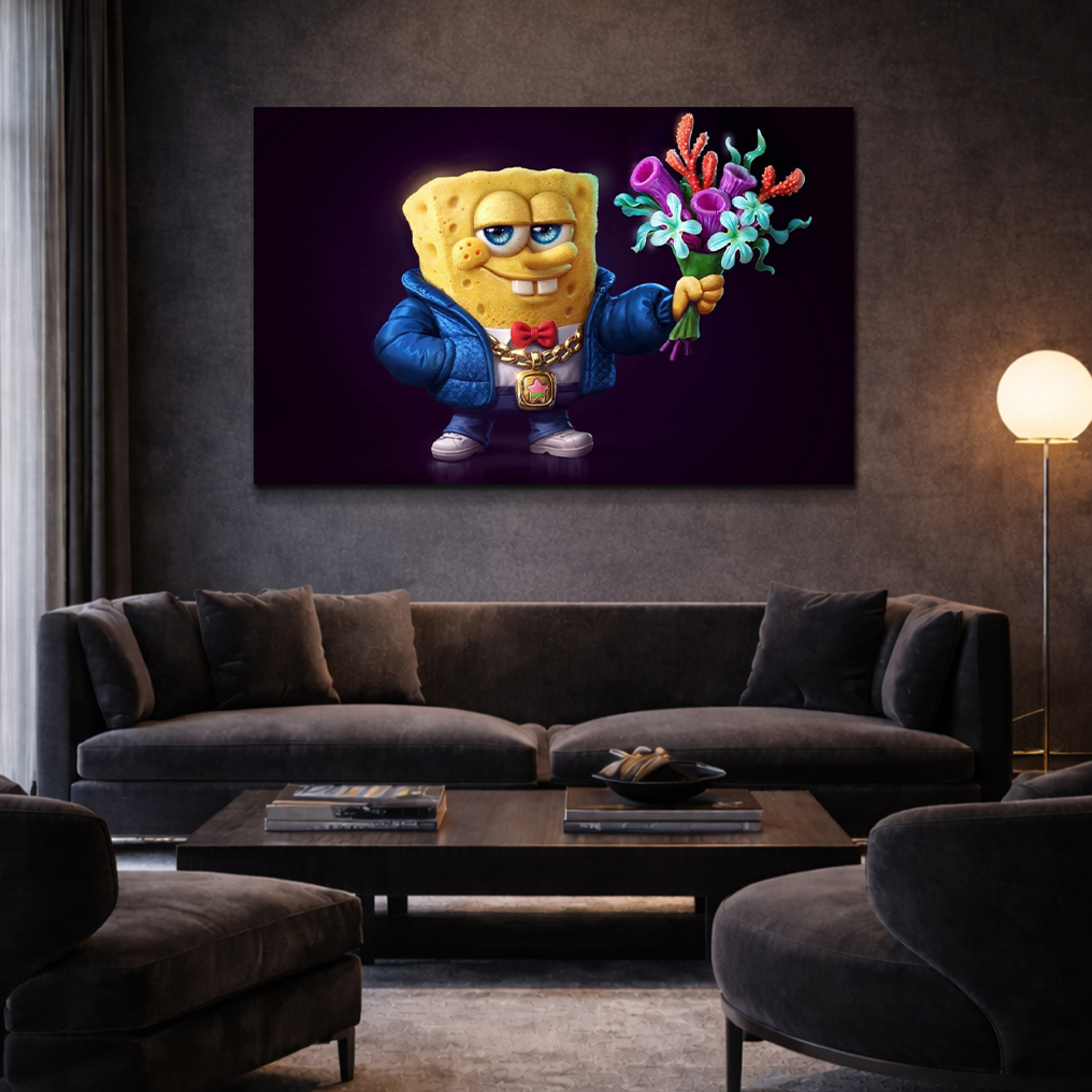
Coral Chic by Gal Yosef depicts SpongeBob dressed in a blue tracksuit, wearing a Patrick pendant on a thick gold chain, and holding a bouquet of coral “flowers.” He looks as though he has just rung the doorbell to pick up his girlfriend before a date.
I could not stop laughing.
Why did the piece resonate so strongly? Because SpongeBob was an indelible part of my children’s childhoods. Even now that they are adults, we still quote this lovable cartoon character.
For me, this artwork is the personification of human delight. It is unexpected, playful, and deeply personal. It transforms a familiar cultural reference into something joyful and new.
And that is precisely the point.

Gal Yosef, Coral Chic, Original Acrylic Painting on Canvas
A More Personal Definition of Beauty
The artworks we choose to live with can do far more than complete a room.
They can awaken a memory, spark a conversation, inspire curiosity, or shift our mood after a long day. They can connect us to a particular moment in our lives or reveal something about our identity that may be difficult to express in words.
The most meaningful interiors are not simply styled. They are felt.
They contain objects and artworks that carry stories. They offer moments of discovery. They create comfort, connection, and delight.
A beautiful home should be more than a reflection of good taste. It should be a reflection of the people who live there.
About Charrisse Johnston

Charrisse Johnston, FASID, Assoc. AIA, LEED AP, WELL AP, is a Principal and founder of StudioSALT in Cape Town.
After earning a BA in Behavioral Biology and an MBA in Management and Marketing, she worked as a strategic planning executive on Wall Street before pursuing a career in interior design. Prior to moving to South Africa, she served as a Principal at Steinberg Hart and as a studio leader at Gensler.
Johnston is Chair-Elect of the Council for Interior Design Qualification and a former Chair of the South African Institute of Interior Design Professions. She is also a Fellow and former Chair of the American Society of Interior Designers. In 2023, she received ASID’s Designer of Distinction Legacy Award, recognizing her career contributions to the advancement of interior design.
She is an executive founding member of the Council of African Interior Architects and Designers and a member of the International WELL Building Institute’s Mind Advisory. She also lectures on the neuroscience of interior design and the ways built environments can influence physical and mental well-being.